6 Team Double Elimination Bracket
A blank 6 team double elimination bracket: upper bracket, lower bracket, grand final and reset, 11 numbered games in all. Every lower bracket slot says which game its team drops from. Print it, or fill it in online.
- 6 teams
- 10 or 11 games
- 3 upper + 3 lower rounds
- 2 first-round byes
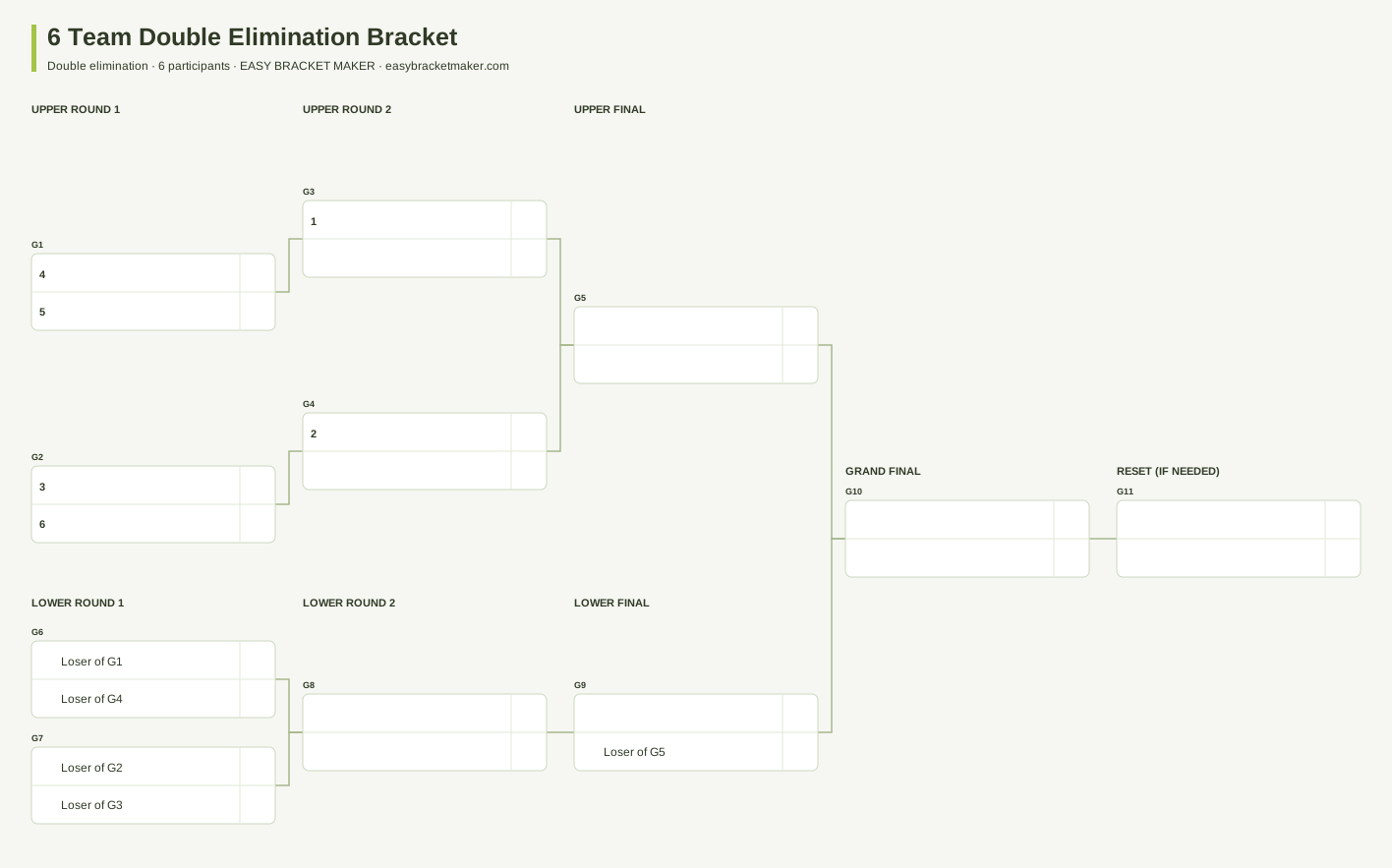
Click the bracket to open it full size.
How a 6 team double elimination bracket works
The upper bracket (winners bracket) is a normal 6 team single elimination bracket, so seeds 1 and 2 get a bye into round 2. It has 3 rounds and 5 games, and its winner reaches the grand final without a loss.
A team that loses in the upper bracket drops into the lower bracket (losers bracket). The lower bracket has 3 rounds and 4 games. Teams that lose later in the upper bracket join later in the lower bracket, and the drop order is reversed to make early rematches less likely. A loss in the lower bracket knocks a team out. The bracket image labels every drop, for example "Loser of G1".
The lower bracket winner has one loss and the upper bracket winner has none. They meet in the grand final (G10). If the lower bracket team wins, both teams have one loss, so a reset game (G11) decides the title. That is why a 6 team double elimination bracket has 10 games, or 11 with the reset.
Every team plays at least 2 games, because a team is only out after its second loss. The most any team can play is 7: a team that loses once in the upper bracket, wins the lower bracket, then wins the grand final and plays the reset.
For the rules that apply at every size, see how a double elimination bracket works.
Order of play
Every game in the bracket, numbered as on the printable sheet. Upper and lower bracket games can run side by side once the games that feed them are finished.
| Round | Game | Matchup |
|---|---|---|
| Upper round 1 | G1 | Seed 4 v Seed 5 |
| G2 | Seed 3 v Seed 6 | |
| Upper round 2 | G3 | Seed 1 v Winner of G1 |
| G4 | Seed 2 v Winner of G2 | |
| Upper final | G5 | Winner of G3 v Winner of G4 |
| Lower round 1 | G6 | Loser of G1 v Loser of G4 |
| G7 | Loser of G2 v Loser of G3 | |
| Lower round 2 | G8 | Winner of G6 v Winner of G7 |
| Lower final | G9 | Winner of G8 v Loser of G5 |
| Grand final | G10 | Winner of G5 v Winner of G9 |
| Reset (if needed) | G11 | Rematch of G10, played only if the lower bracket team wins it |
6 teams in other formats
| Format | Games | Games per team | Time slots |
|---|---|---|---|
| 6 team single elimination bracket | 5 | 1 to 3 | 3 |
| 6 team double elimination bracket | 10 or 11 | 2 to 7 | 6 or 7 |
| 6 team round robin schedule | 15 | 5 | 5 |
| Swiss system | 9 | 3 | 3 |
Fill it in online
Open this bracket in Easy Bracket Maker to type in real team names, keep this seeding or shuffle it, and enter scores as games finish. Winners move on automatically and losers drop to the right lower bracket game. Export it as SVG, PNG, CSV or a printable sheet, or send players a link. It runs in your browser and saves on your device; there is no account.
Open the 6 team bracket →Other sizes
For a different number of teams, see the 5 team double elimination bracket or the 7 team double elimination bracket, or pick any size below.
- 3 teams
- 4 teams
- 5 teams
- 6 teams
- 7 teams
- 8 teams
- 9 teams
- 10 teams
- 11 teams
- 12 teams
- 13 teams
- 14 teams
- 15 teams
- 16 teams
- 17 teams
- 18 teams
- 19 teams
- 20 teams
- 21 teams
- 22 teams
- 23 teams
- 24 teams
- 25 teams
- 26 teams
- 27 teams
- 28 teams
- 29 teams
- 30 teams
- 31 teams
- 32 teams
Questions
How many games are in a 6 team double elimination bracket?
10, or 11 if the grand final goes to a reset. Every team except the champion loses exactly twice, which makes 10 games; the reset is the one extra game, played when the champion has also lost once.
Who gets a bye in a 6 team double elimination bracket?
Seeds 1 And 2. 6 teams go into a 8-slot bracket, which leaves 2 empty slots. The byes go to the top seeds, who start in round 2, so a higher seed earns an easier path.
How many games does each team play?
At least 2 and at most 7.
How long does a 6 team double elimination tournament take?
With one court and 30-minute games, the 10 games take 5 hours back to back (5.5 hours with a reset). With enough courts to play every ready game at once, it takes 6 rounds (7 with a reset), because each game waits for the games that feed it.
What is a grand final reset?
The upper bracket winner reaches the grand final unbeaten. If the lower bracket team wins it, both teams have one loss, so one more game decides the champion.