Swiss System Tournament Generator
Free Swiss system tournament generator: standings-based pairings, no rematches, rotating byes. For chess, Magic, esports and league nights. No account.
A Swiss tournament runs a fixed number of rounds and nobody is eliminated. Each round pairs players on the same or a similar score, avoiding rematches, so after a few rounds the standings sort the whole field. It is the standard format for chess, Magic: The Gathering and large esports opens, where double elimination would take too long.
Create a Swiss tournament →How many rounds?
Enough rounds to leave one player with a perfect score: log₂ of the number of players, rounded up. That is also what the app schedules.
| Players | Rounds | Games per round (max) |
|---|---|---|
| 2 | 1 | 1 |
| 3 to 4 | 2 | 2 |
| 5 to 8 | 3 | 4 |
| 9 to 16 | 4 | 8 |
| 17 to 32 | 5 | 16 |
| 33 to 64 | 6 | 32 |
| 65 to 128 | 7 | 64 |
How Swiss pairings work
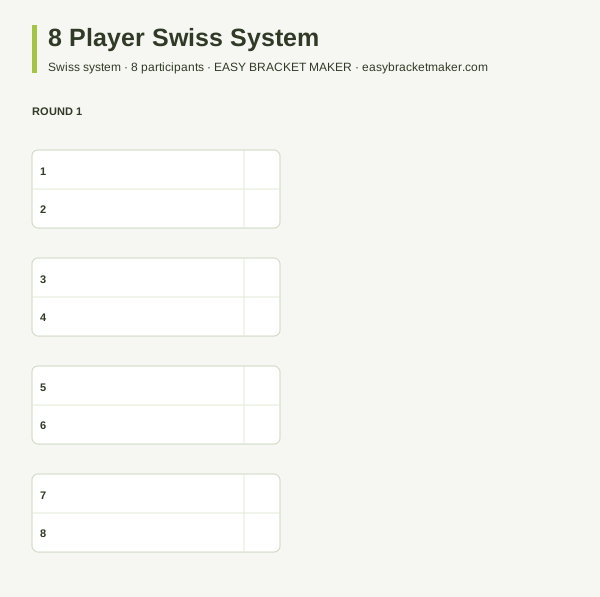
Round 1 pairs the field by seed. After each round, players are ranked by points (3 for a win, 1 for a draw). Each player is paired with the highest-ranked player on a similar score whom they have not played yet. With an odd number of players, the lowest-ranked player who has not had a bye sits out and scores a win.
Later rounds depend on earlier results, so a Swiss draw cannot be printed in advance beyond round 1. Run it in the app and it pairs each round when the previous one is complete.
Example: 8 players, round 1
Questions
How many rounds does a Swiss tournament need?
Enough to separate the field: log₂ of the number of players, rounded up. 8 players need 3 rounds, 9 to 16 need 4, 17 to 32 need 5, 33 to 64 need 6.
How are Swiss pairings decided?
After each round, players are ranked by points. Each is paired with the highest-ranked opponent on a similar score they have not yet played. With an odd number, the lowest-ranked player without a previous bye sits out and scores a win.
Can two players meet twice?
The pairing avoids rematches whenever a valid set of pairings exists. In very small fields with many rounds that is sometimes impossible, and then the closest pairing is used.
Is this a FIDE-rated pairing system?
No. It is a general-purpose Swiss pairing for clubs and events, not a certified Dutch-system implementation.